Zaya Engine

Zaya Engine
A small Vulkan game engine with a separate Electron-based editor.
Showcase video on YouTube, click on the image:
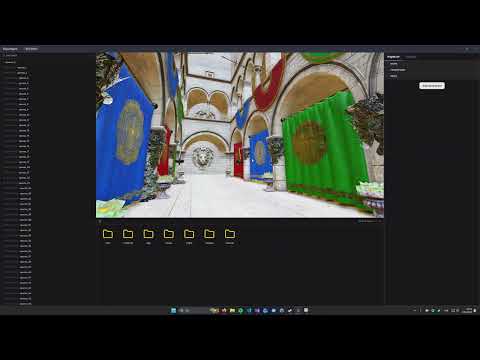
Backend (C++) is a Vulkan PBR forward renderer. Frontend (editor, TypeScript) is an Electron app written in Svelte. These layers communicate between each other using a WebSocket.
Features
Renderer (Vulkan)
- PBR forward renderer
- HDR equirectangular skybox loading and runtime environment switching
- SSAO with a normals prepass and separable blur (courtesy of Claude Code)
- Asset loading via Assimp —
.obj,.gltfand other Assimp-supported formats - Double-buffered frame-in-flight rendering, dynamic swapchain recreation
- ImGuizmo transform handles
ECS
- Built-in components: Transform, MeshRenderer, Camera, Light, Name, LuaScript
Lua scripting (sol2)
- Per-entity environments with
OnStart(entity)/OnUpdate(entity, dt)lifecycle - Bound APIs:
Entity(get/set position, rotation, scale),Input.isKeyHeld,Time.deltaTime - Use via editor's
LuaScriptComponent
Editor (Electron + Svelte 5)
- Native engine viewport embedded inside the Electron window
- Hierarchy panel, Inspector with per-component editors, Asset browser, Settings view
- Transform gizmos (translate / rotate / scale)
- HDR environment picker, mesh import, material editor
Two run modes
ZayaEditor— engine + editor bridge for authoringZayaRuntime— standalone runtime that loads a scene and runs scripts, doesn't load websocket stuff
Architecture
The engine and editor are separate processes that communicate over a local WebSocket.
The editor sends typed commands (e.g. scriptComponent.scriptPath, input.key, transform edits) as JSON; the engine dispatches them through CommandDispatcher to handlers registered by each system. This split means the editor can be developed, hot-reloaded, and restyled entirely in the JS/Svelte ecosystem without rebuilding C++.
Requirements
- Windows (the engine uses Win32 APIs for window embedding; not portable as-is)
- Vulkan SDK
- Visual Studio 2022 with the C++ workload, plus
msbuildon PATH - premake5 on PATH (for regenerating project files)
- Node.js with pnpm (npm also works)
Build & run
First-time setup (installs editor dependencies):
pnpm run install:editor
Build the engine and launch the editor:
pnpm run dev:engine
Run only the editor frontend, skipping the engine build (useful for UI work):
pnpm run dev:noengine
Regenerate Visual Studio project files after changing premake5.lua:
pnpm run build:engine
Project layout
engine/             C++ engine sources and vendored dependencies
  src/              First-party engine code
    ECS/            Component pools, scene, systems
    editor/         WebSocket bridge, EditorLayer, gizmos
    runtime/        Standalone runtime entry point
    core/           Window, scene manager, config
  vendor/           assimp, glfw, imgui, ixwebsocket, lua, sol2, ...
editor/             Electron + Svelte editor
  src/main/         Electron main process
  src/renderer/     Svelte UI (Hierarchy, Inspector, Asset browser, ...)
assets/             Sample scenes, meshes, shaders (GLSL + SPIR-V), textures, scripts
config/             Engine.ini
Sample script
-- assets/scripts/example.lua
local speed = 5.0

function OnStart(entity)
    print("OnStart: entity " .. tostring(entity.id))
end

function OnUpdate(entity, dt)
    local pos = entity:getPosition()
    local dx, dz = 0, 0
    if Input.isKeyHeld("W") then dz = dz - speed * dt end
    if Input.isKeyHeld("S") then dz = dz + speed * dt end
    if Input.isKeyHeld("A") then dx = dx - speed * dt end
    if Input.isKeyHeld("D") then dx = dx + speed * dt end
    if dx ~= 0 or dz ~= 0 then
        entity:setPosition(pos.x + dx, pos.y, pos.z + dz)
    end
end
Third-party
Vendored under engine/vendor/: Assimp, GLFW, Dear ImGui + ImGuizmo, IXWebSocket, Lua, sol2, nlohmann/json, simpleini, SPIRV-Reflect, stb. Each retains its original license.
The ECS is based on David Colson's "Making a Simple ECS".
License
MIT — see LICENSE.
